Just a short post for tonight. I should have something more formal in the next couple days, but until then, mull this over. I am 18 years old, and I am farely involved in video games. Many people ahead of me in age and below me in age are involved and exposed to video games at a good level. In fact, as of the past two generations, we are very involved with video games and technology, for the matter. The recent naming of the next generation (iGeneration) brings something to my mind. Adults these days are a little or not at all involved in video games and major forms of technology. But as we all grow up, involvement in these things grows. The decade of kids behind me are VERY exposed to video games, and by the time they become my age, video games will be commonplace among them all in some form.
What does this mean? Well, it means that as the new era of adults, we must realize that we are starting a real shift in perspective. We will be the first people to be fully influenced and active in technology and entertainment current day adults are not exposed to. We will be the first to really accept in this country video games as a viable way of entertainment and value. Think of it. Up until now, video games have not had good marks in today's day and age. They were considered vessels for violence in the 90's. In the last decade they have become in many heads the worst type of entertainment for children, causing them to become lazy. Now, heading into a new decade, realize the situation. The average gamer has gone from someone in their teens to someone in their thirties in a matter of ten years. The age barrier of games is being broken, and games are becoming much more acceptable.
In my opinion, it's very possible that in ten years, video games will be on the same platform as movies, television, and even some sports. We will be the first generation fully exposed to these things and accepting of them. It doesn't seem like that big of a deal, but realizing that the new generation of adults will be coming in with the experience and enjoyment of technologies usually associated with young people is interesting.
What do you think? Is my idea interesting, or a bunch of crap? How do you see video games fitting in the world in the future? Are their changes in store, or are we destined for more of the same? Please comment! It's what keeps this blog alive and wanting to post more!
Tuesday, February 16, 2010

Wednesday, February 10, 2010
5 Things You Should Know About Reviews
As I sit here in my bed sick as a dog today, I felt I should write a post. Because there's nothing better than writing a blog when you're sick. Sarcasm for the win. Anyway, the post I have for you today is one I actually came up with when I was doing something I do almost every day: reading a game review. As I was reading this review of an undisclosed game from and undisclosed website, I realized just how much caution gamers need to take so they don't lose their money to a bad game and so they don't rely on the media to determine what they will and will not like. Unfortunately, the only way to know good things about games is to listen to the media about them. It's quite the Catch-22. So I came up with 5 things every gamer should take caution of when they go to the media for game information.
1. Be careful of the reviews.
As I have always said in this blog and in my opinions, there is no such things as an unbiased review of a game. Whether a game is reviewed by one person, several people, tons of people, or even the whole planet, bias will seep in. It's impossible for the human mind to remain completely objective about anything. We all have opinions, tastes, and differences. This applies to games. Readers of reviews need to know this in order to gain anything from reading the review. When a gamer reads a review, they need to know that the person reviewing the game (hopefully) played the game through, and garnered his/her own opinions about it. Some reviewers could like a racing game because they love racing games, and they may be less harsh on a game that may be flawed in the racing genre because of that love. Others may bash the game harshly because they hate racing games, and therefore cast a much more critical eye on the game. It isn't their faults they do this. That's just their preferences as a gamer. Just as one person may be more critical of the government than another, or one person may prefer english instead of math, gamers are different. This is not a bad thing. It's what makes gaming such an awesome community. It's just something that should be considered when reading a review. No review is objective.
2. Read multiple reviews.
Once you realize that all reviews are biased in some form, everyone should come to a decent conclusion: if you're really curious about a game, you should read multiple reviews. Just as a good voter should take in all opinions, gamers should really look at multiple opinions about a game to judge it correctly. Reviews all have things in common: they go over the good and the bad. Some reviews may have more of one or the other, but it's a guarantee that each review will have something in common with the others. If something in a game is most evidently a good thing, most reviews will mention it in some way. If something is blatantly bad in a game, reviews will also mention it. It's the idea of grabbing the similarities out of comparisons that can really show what a game is. Because even if reviews are biased, the fact that they all have the same thing highlighted in them guarantees validity. For example, if 10 reviews state that a particular game has a bad storyline, you can gain the following conclusions just from knowing that this was mentioned in those reviews: that the idea of having a bad storyline is not made up since multiple people noted it, and that the storyline is bad because most people noted it was bad. This is how you can really tell if a game is of value or not.
3. Pick good reviews to read.
This may seem obvious to some, but the internet is full of shit. Absolute, undeniable, bullshit. This includes game reviewers. There are a hell of a lot of websites and reviewers out there who do not know what they are talking about at any moment of the day. They just want to fill your head with the worst crap ever. I don't intend to list these people who dilute their reviews to publicity stunts, but I can tell you great websites that are super trustworthy and do care about delivering the best reviews possible. This is because these websites are made up of gamers just like you and me, and these websites actually play each game thoroughly to make sure they are as truthful as possible. IGN, 1up, GameTrailers, GameInformer, and GamePro are all great industry leaders in reviews and gaming overall. Each website provides the best information and the most in depth reviews possible, and they are truthful about their reviews. In particular, you'll find great writing on IGN and great video reviews on GameTrailers. Using these websites to read your reviews will never steer you wrong. Other websites such as Destructoid and Kotaku are much less professional and much more laid back, but they are still great places to read reviews. They offer a much more personal touch to reviews as they are smaller, and they seem to pick out things many bigger companies forget.
4. Avoid aggregators.
Throughout this post I have been emphasizing the fact that reading multiple reviews is key to gaining something from them. Some websites have seen the value in this idea, but they have gone around the idea and taken the easy way out instead of being thorough. These are websites like Metacritic and Rotten Tomatoes, called aggregators. They assemble all the scores given from reviews from every website on the internet, average the scores, and give the game a score based on the average. This may sound like a good idea at first, since the idea is to get rid of the reading you have to do and just give you a sound score based on many reviews. The problem with this is that it narrows game reviews down to a number. Always remember that game reviewers assign numbers and grades in order to summarize their own individual review. It's to help the understanding of their review, not a replacement for their review. And it's for their individual review. Every website has a completely different way of scoring or grading, and it's not fair or good to take all the numbers/letters, average them, and spit out a number. Don't think aggregators are a fair way to find good games. If you want a good game, take the time to find one. Don't fall in the trap of aggregators.
5. Stay true to what you want.
Never, ever, EVER let a review completely stop you from getting a game you know you would enjoy. Just because a game doesn't get a 10 or an A+ doesn't mean that it's a bad game. Many games get scores of in the 7's and 8's. They are amazing games. They aren't perfect games, but how many games are anyway? Never think that buying a game that got some bad reviews is a bad thing. If you felt that some reviews were unjust and that you do think you'd like the game, go ahead and try it. Reviews can never tell you if you like a game or not. They can only give you perspective from another person's eyes about a game. They are there to help, not to replace your decision-making skills. This is why when I do reviews, I never put a number or a letter grade. Although these are great techniques and appropriate for those companies that use them, it doesn't work for my reviews. I own and have played multiple games that have NOT gotten top scores. I enjoyed them. Scores are not a review. A review is a review. And always take into context multiple reviews and your own opinions about a game before you even think about a score. This is why reviewers always put the score at the end of the review, and not the beginning.
I hope this helps in your review reading and your game decisions. I know it took a while for me to learn how to really read reviews properly. As I have experienced with the blog, it is not easy by any means to write a good review of a game. It's tough. So while your reading a review know that a lot of work goes into it. Good hunting.
1. Be careful of the reviews.
As I have always said in this blog and in my opinions, there is no such things as an unbiased review of a game. Whether a game is reviewed by one person, several people, tons of people, or even the whole planet, bias will seep in. It's impossible for the human mind to remain completely objective about anything. We all have opinions, tastes, and differences. This applies to games. Readers of reviews need to know this in order to gain anything from reading the review. When a gamer reads a review, they need to know that the person reviewing the game (hopefully) played the game through, and garnered his/her own opinions about it. Some reviewers could like a racing game because they love racing games, and they may be less harsh on a game that may be flawed in the racing genre because of that love. Others may bash the game harshly because they hate racing games, and therefore cast a much more critical eye on the game. It isn't their faults they do this. That's just their preferences as a gamer. Just as one person may be more critical of the government than another, or one person may prefer english instead of math, gamers are different. This is not a bad thing. It's what makes gaming such an awesome community. It's just something that should be considered when reading a review. No review is objective.
2. Read multiple reviews.
Once you realize that all reviews are biased in some form, everyone should come to a decent conclusion: if you're really curious about a game, you should read multiple reviews. Just as a good voter should take in all opinions, gamers should really look at multiple opinions about a game to judge it correctly. Reviews all have things in common: they go over the good and the bad. Some reviews may have more of one or the other, but it's a guarantee that each review will have something in common with the others. If something in a game is most evidently a good thing, most reviews will mention it in some way. If something is blatantly bad in a game, reviews will also mention it. It's the idea of grabbing the similarities out of comparisons that can really show what a game is. Because even if reviews are biased, the fact that they all have the same thing highlighted in them guarantees validity. For example, if 10 reviews state that a particular game has a bad storyline, you can gain the following conclusions just from knowing that this was mentioned in those reviews: that the idea of having a bad storyline is not made up since multiple people noted it, and that the storyline is bad because most people noted it was bad. This is how you can really tell if a game is of value or not.
3. Pick good reviews to read.
This may seem obvious to some, but the internet is full of shit. Absolute, undeniable, bullshit. This includes game reviewers. There are a hell of a lot of websites and reviewers out there who do not know what they are talking about at any moment of the day. They just want to fill your head with the worst crap ever. I don't intend to list these people who dilute their reviews to publicity stunts, but I can tell you great websites that are super trustworthy and do care about delivering the best reviews possible. This is because these websites are made up of gamers just like you and me, and these websites actually play each game thoroughly to make sure they are as truthful as possible. IGN, 1up, GameTrailers, GameInformer, and GamePro are all great industry leaders in reviews and gaming overall. Each website provides the best information and the most in depth reviews possible, and they are truthful about their reviews. In particular, you'll find great writing on IGN and great video reviews on GameTrailers. Using these websites to read your reviews will never steer you wrong. Other websites such as Destructoid and Kotaku are much less professional and much more laid back, but they are still great places to read reviews. They offer a much more personal touch to reviews as they are smaller, and they seem to pick out things many bigger companies forget.
4. Avoid aggregators.
Throughout this post I have been emphasizing the fact that reading multiple reviews is key to gaining something from them. Some websites have seen the value in this idea, but they have gone around the idea and taken the easy way out instead of being thorough. These are websites like Metacritic and Rotten Tomatoes, called aggregators. They assemble all the scores given from reviews from every website on the internet, average the scores, and give the game a score based on the average. This may sound like a good idea at first, since the idea is to get rid of the reading you have to do and just give you a sound score based on many reviews. The problem with this is that it narrows game reviews down to a number. Always remember that game reviewers assign numbers and grades in order to summarize their own individual review. It's to help the understanding of their review, not a replacement for their review. And it's for their individual review. Every website has a completely different way of scoring or grading, and it's not fair or good to take all the numbers/letters, average them, and spit out a number. Don't think aggregators are a fair way to find good games. If you want a good game, take the time to find one. Don't fall in the trap of aggregators.
5. Stay true to what you want.
Never, ever, EVER let a review completely stop you from getting a game you know you would enjoy. Just because a game doesn't get a 10 or an A+ doesn't mean that it's a bad game. Many games get scores of in the 7's and 8's. They are amazing games. They aren't perfect games, but how many games are anyway? Never think that buying a game that got some bad reviews is a bad thing. If you felt that some reviews were unjust and that you do think you'd like the game, go ahead and try it. Reviews can never tell you if you like a game or not. They can only give you perspective from another person's eyes about a game. They are there to help, not to replace your decision-making skills. This is why when I do reviews, I never put a number or a letter grade. Although these are great techniques and appropriate for those companies that use them, it doesn't work for my reviews. I own and have played multiple games that have NOT gotten top scores. I enjoyed them. Scores are not a review. A review is a review. And always take into context multiple reviews and your own opinions about a game before you even think about a score. This is why reviewers always put the score at the end of the review, and not the beginning.
I hope this helps in your review reading and your game decisions. I know it took a while for me to learn how to really read reviews properly. As I have experienced with the blog, it is not easy by any means to write a good review of a game. It's tough. So while your reading a review know that a lot of work goes into it. Good hunting.
Sunday, February 7, 2010
Mass Effect 2
Mass Effect 2 could not have been more anticipated in the gaming world. The sequel to possibly the greatest western RPG is not something to be taken lightly. Mass Effect 2, plain and simple, is the best opener for 2010. Mass Effect made people want more of the same, and yet something different. It make dedicated players remain dedicated, and it made newcomers to the RPG genre a little less scared of the millions of titles available. BioWare is no newcomer to the RPG scene, and they showed their potential with Mass Effect. Have they truly delivered with Mass Effect 2, or have they left the franchise in the dust?
Paragon Acts
-Grandpa, tell us a story: The Mass Effect franchise, in my opinion, is one of the greatest sci-fi stories ever told, and Mass Effect 2 does NOT dissapoint. The story of an Alliance soldier by the name of Shepard in Mass Effect 1 was amazing, and it only gets better. Not to spoil the fun, but the way this game throws a completely new twist literally from the beginning of the game is something not many games can replicate. Top this with several other twists, amazing events and a fluid and comprehesible story, and you have one of the best stories in a video game EVER. Time and time again, BioWare proves that they are the best storytellers in video games. Mass Effect 2 only solidifies this.
-With all these friends, how could I be sad?: Like the first game, Mass Effect 2 introduces some very unique and interesting characters. Mass Effect 2 has the best cast I have ever seen in a video game. This is because each character is completely different, and adds a completely different layer to the game. You have an old and reliable friend who went through Hell with you. You have a fast-talking scientist who truly believes himself correct, even though he will kill if he needs to. You have a lifelong assassin, whose past is shrouded in mystery, but seems to carry a strict and almost humble code of honor and remorse. Each person is different, and each story is different, which makes the prospect of having to take these team members into Hell one of excitement and one of fear over the possibility of losing them. And as that feeling becomes evident, so does the fact that the characters also help build you as your own Shepard. Pretty cool.
-Make me over: One thing that this game did really well was to give you the ability, if you did play Mass Effect 1, to completely edit your character. The game doesn't force you to stick with the same look and the same class that you had in the first. Now, the reason this is cool is that your remodeling is actually central to the story. Without giving the story away, BioWare does a fantastic job at explaining how it is possible that your existing character could be completely different looking and have completely new abilities. It never feels cheap, and it fits in great.
-The Dark Knight factor: Mass Effect 2 is one of the few examples I can think of that displays a true sequel in every way. BioWare took some chances with Mass Effect 2. They revamped the entire system for the sequel, and needless to say, the game is quite different than it's predecessor in many ways. The fact that not only did this risk pay off extremely well, but that everything about this game is ten times better and preferable over its predecessor, indicates the real sequel Mass Effect 2 is. Most sequels build on what's been established, and while Mass Effect 2 does that with story and existing universe, it creates an entirely new gameplay experience years ahead of the original. Things every sequel should be.
-Throw me a mag: I was sceptical about Mass Effect 2's ammo system. Since the first game had unlimited ammo and weapons only overheated, revamping with an ammo system to me felt a little dangerous. Well, I'm proud to say I was wrong. The ammo system is such a blessing. Weapons feel like actual weapons, where I have to manage the amount of ammo I shoot. It makes me more cautious about how I shoot. It feels like an actual shooter, as it should. And once again, BioWare made sure to explain the change in no-ammo to ammo in the story, which is great.
-Weapon of choice: Just as the first did, the second game amazes me in it's deep and involved morality system. I was promised when I played Mass Effect 1 that every choice I made would affect the world in the sequel. This is a hard proposition, and most developers would probably not follow up on this. Mass Effect 2 is a promise fulfilled. Every choice I made, EVERY ONE, had some effect in this game. Even the little ones. People I saved rather than killed appeared out of nowhere, thanking me for saving them or hating me for not killing them. People I had relationships with had different views of me depending on my previous choices. The biggest of decisions caused repurcusions that affect lives in Mass Effect 2. The smallest of decisions seem to escalate to become bigger. By far, this is the greatest pun in all of gaming. This game creates such a "mass effect" with choices.
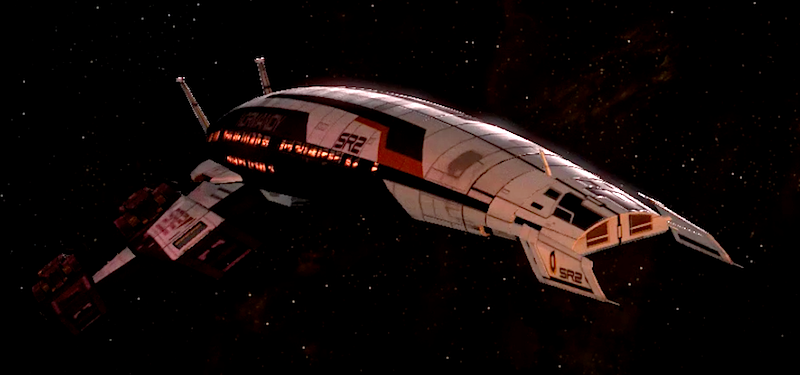
-Omaha Beach: The second Normandy is such a highlight of this game. First off, whoever pollishes the Normandy SR-2 does a hell of a job. The ship is so shiny. Seriously though, this ship feels like a real and antive spaceship. There are so many improvements, and so many welcome additions. Of note is the AI named EDI, voiced by Tricia Helfer. It's a great addition to the ship, and it really makes the ship as an upgrade that much more evident. The Normandy has also gotten rid of something: the incredible slow elevator. Thank God. That elevator was mind-crippling.
-Let me be myself: Mass Effect 1 did a great job with giving you customization options. Mass Effect 2 does it so much more and better. Armor now consists of parts, and each part can be customized and switched to fit your combat type. Color, pattern, and material can all be edited to the full extent to make your Shepard really yours. Another cool addition is that of upgrades. Several upgrades can be researched to upgrade yourself, your teammates, and even your ship. And the cool thing is that these upgrades are very important to the story, especially ship upgrades. And by important I mean life or death. If that isn't real customization I don't know what is.
Renegade Acts
-Arbiter?: One of the few flaws of this game is that it ditches one of the great characters of the first game: Captain Anderson. The Captain was a central character in the first game, and is barely included in the second. Depending on whether you picked Anderson for the Council or not, his role in the game could potentially be even less. It is sad to see that a great character is not included or relevant in the sequel. Although it is understandable why he isn't relevant in the story, it is still sad. Here's hoping Anderson gets a bigger role in Mass Effect 3.
-Jump around: A somewhat sad side affect of the longer story in Mass Effect 2 is that side quests are very much minimalized. Although I don't think the number of side quests are less, they are much harder to find and there is much less incentive to do them. This may be because many optional missions, such as the N7 and loyalty missions, don't really feel like side quests, but optional main quest missions. Although this is good, it does put the side-quester in a box.
-Za...za...whatever the hell his name is: Zaeed Messani is a terrible character. Now, he did come out of day one DLC, so it can't be blamed that he is that bad. But he just seems to have no emotion or anything that would make a player emotionally invest in him like all the other characters. Oh yeah, and the fact that he is a complete asshole doesn't help either. Normally I wouldn't complain about an asshole character in a game, but this guy is so annoying and stupid and useless that he feels like a real-life asshole. Again, BioWare explains this well, as he is just a gun for hire, rather than all your other members who are there for emotional reasons.
-Chicken scratch: There is one area where Mass Effect 2 doesn't improve: subtitles. The original game had the bad problem of unreadable text when played on a standard definition television. Mass Effect 2 does not fix this. Now, I personally don't have this problem as I play on an HD TV. But the fact that millions of people have standard TV's and they can't read the text ruins the experience for them. Could this be a sign that companies want you to buy a new TV? Maybe. But until then, I hope you can hear dialogue well if you are playing on a standard TV.
-What happened while I was gone?: One of the great places in Mass Effect 1 was the Citadel. It was the biggest, coolest, and most friendly place in the galaxy in the first game. The Citadel doesn't feel this way at all in the sequel. In fact, it's been downsized quite a bit. Where it had a full upper ward, lower ward, presidium, c-sec, and citadel tower, Mass Effect 2 has only about 3 continuous zones. Although Zakera Ward is interesting and full of cool things, It doesn't have the scope that you learned to know and love from the first. By far the most dissapointing of the Citadel is the presidium, which used to be a gigantic plaza, but is now a room where you can see the plaza, but not walk in it. These things could be because of the new setting and context of the game, but it's still a little bit of a shock to see the Citadel in a new way.
Thing You May have Missed
-The salarian scientist you recruit named Mordin Solus has some very interesting coversation topics. One of the best is when you find out he once did musical theatre. Upon more investigation, you figure out he performed Gilbert and Sullivan. He even goes to sing some of the chorus. "I am the perfect model of a scientist salarian..."
Final Comments
Don't pass your days of life without playing this blessed game. Mass Effect 2 is such a marvel in the industry of video games. BioWare has crafted a masterpiece in every way in this game. I can try my hardest not to exaggerate what this game is or how I really loved it. But the more I try the more resistance is futile. Mass Effect 2 succeeds in every way, whether that be story, gameplay, community, lore, or anything else imaginable. Games like these only come once in a while, and they seem to come at the most oppurtune moments. Mass Effect 2 is one of these games. One work of advice, though: although this game is extraordinary, it is only amazing with the context of playing the first game. These games are meant to be played as a series. Realizing your choices will bleed into new games is a great experience, unlike any other. Is is too soon to nominate a game for Game of the Year? Because this one is most definitely a STRONG contender.
Paragon Acts
-Grandpa, tell us a story: The Mass Effect franchise, in my opinion, is one of the greatest sci-fi stories ever told, and Mass Effect 2 does NOT dissapoint. The story of an Alliance soldier by the name of Shepard in Mass Effect 1 was amazing, and it only gets better. Not to spoil the fun, but the way this game throws a completely new twist literally from the beginning of the game is something not many games can replicate. Top this with several other twists, amazing events and a fluid and comprehesible story, and you have one of the best stories in a video game EVER. Time and time again, BioWare proves that they are the best storytellers in video games. Mass Effect 2 only solidifies this.
-With all these friends, how could I be sad?: Like the first game, Mass Effect 2 introduces some very unique and interesting characters. Mass Effect 2 has the best cast I have ever seen in a video game. This is because each character is completely different, and adds a completely different layer to the game. You have an old and reliable friend who went through Hell with you. You have a fast-talking scientist who truly believes himself correct, even though he will kill if he needs to. You have a lifelong assassin, whose past is shrouded in mystery, but seems to carry a strict and almost humble code of honor and remorse. Each person is different, and each story is different, which makes the prospect of having to take these team members into Hell one of excitement and one of fear over the possibility of losing them. And as that feeling becomes evident, so does the fact that the characters also help build you as your own Shepard. Pretty cool.
-Make me over: One thing that this game did really well was to give you the ability, if you did play Mass Effect 1, to completely edit your character. The game doesn't force you to stick with the same look and the same class that you had in the first. Now, the reason this is cool is that your remodeling is actually central to the story. Without giving the story away, BioWare does a fantastic job at explaining how it is possible that your existing character could be completely different looking and have completely new abilities. It never feels cheap, and it fits in great.
-The Dark Knight factor: Mass Effect 2 is one of the few examples I can think of that displays a true sequel in every way. BioWare took some chances with Mass Effect 2. They revamped the entire system for the sequel, and needless to say, the game is quite different than it's predecessor in many ways. The fact that not only did this risk pay off extremely well, but that everything about this game is ten times better and preferable over its predecessor, indicates the real sequel Mass Effect 2 is. Most sequels build on what's been established, and while Mass Effect 2 does that with story and existing universe, it creates an entirely new gameplay experience years ahead of the original. Things every sequel should be.
-Throw me a mag: I was sceptical about Mass Effect 2's ammo system. Since the first game had unlimited ammo and weapons only overheated, revamping with an ammo system to me felt a little dangerous. Well, I'm proud to say I was wrong. The ammo system is such a blessing. Weapons feel like actual weapons, where I have to manage the amount of ammo I shoot. It makes me more cautious about how I shoot. It feels like an actual shooter, as it should. And once again, BioWare made sure to explain the change in no-ammo to ammo in the story, which is great.
-Weapon of choice: Just as the first did, the second game amazes me in it's deep and involved morality system. I was promised when I played Mass Effect 1 that every choice I made would affect the world in the sequel. This is a hard proposition, and most developers would probably not follow up on this. Mass Effect 2 is a promise fulfilled. Every choice I made, EVERY ONE, had some effect in this game. Even the little ones. People I saved rather than killed appeared out of nowhere, thanking me for saving them or hating me for not killing them. People I had relationships with had different views of me depending on my previous choices. The biggest of decisions caused repurcusions that affect lives in Mass Effect 2. The smallest of decisions seem to escalate to become bigger. By far, this is the greatest pun in all of gaming. This game creates such a "mass effect" with choices.
-Omaha Beach: The second Normandy is such a highlight of this game. First off, whoever pollishes the Normandy SR-2 does a hell of a job. The ship is so shiny. Seriously though, this ship feels like a real and antive spaceship. There are so many improvements, and so many welcome additions. Of note is the AI named EDI, voiced by Tricia Helfer. It's a great addition to the ship, and it really makes the ship as an upgrade that much more evident. The Normandy has also gotten rid of something: the incredible slow elevator. Thank God. That elevator was mind-crippling.
-Let me be myself: Mass Effect 1 did a great job with giving you customization options. Mass Effect 2 does it so much more and better. Armor now consists of parts, and each part can be customized and switched to fit your combat type. Color, pattern, and material can all be edited to the full extent to make your Shepard really yours. Another cool addition is that of upgrades. Several upgrades can be researched to upgrade yourself, your teammates, and even your ship. And the cool thing is that these upgrades are very important to the story, especially ship upgrades. And by important I mean life or death. If that isn't real customization I don't know what is.
Renegade Acts
-Arbiter?: One of the few flaws of this game is that it ditches one of the great characters of the first game: Captain Anderson. The Captain was a central character in the first game, and is barely included in the second. Depending on whether you picked Anderson for the Council or not, his role in the game could potentially be even less. It is sad to see that a great character is not included or relevant in the sequel. Although it is understandable why he isn't relevant in the story, it is still sad. Here's hoping Anderson gets a bigger role in Mass Effect 3.
-Jump around: A somewhat sad side affect of the longer story in Mass Effect 2 is that side quests are very much minimalized. Although I don't think the number of side quests are less, they are much harder to find and there is much less incentive to do them. This may be because many optional missions, such as the N7 and loyalty missions, don't really feel like side quests, but optional main quest missions. Although this is good, it does put the side-quester in a box.
-Za...za...whatever the hell his name is: Zaeed Messani is a terrible character. Now, he did come out of day one DLC, so it can't be blamed that he is that bad. But he just seems to have no emotion or anything that would make a player emotionally invest in him like all the other characters. Oh yeah, and the fact that he is a complete asshole doesn't help either. Normally I wouldn't complain about an asshole character in a game, but this guy is so annoying and stupid and useless that he feels like a real-life asshole. Again, BioWare explains this well, as he is just a gun for hire, rather than all your other members who are there for emotional reasons.
-Chicken scratch: There is one area where Mass Effect 2 doesn't improve: subtitles. The original game had the bad problem of unreadable text when played on a standard definition television. Mass Effect 2 does not fix this. Now, I personally don't have this problem as I play on an HD TV. But the fact that millions of people have standard TV's and they can't read the text ruins the experience for them. Could this be a sign that companies want you to buy a new TV? Maybe. But until then, I hope you can hear dialogue well if you are playing on a standard TV.
-What happened while I was gone?: One of the great places in Mass Effect 1 was the Citadel. It was the biggest, coolest, and most friendly place in the galaxy in the first game. The Citadel doesn't feel this way at all in the sequel. In fact, it's been downsized quite a bit. Where it had a full upper ward, lower ward, presidium, c-sec, and citadel tower, Mass Effect 2 has only about 3 continuous zones. Although Zakera Ward is interesting and full of cool things, It doesn't have the scope that you learned to know and love from the first. By far the most dissapointing of the Citadel is the presidium, which used to be a gigantic plaza, but is now a room where you can see the plaza, but not walk in it. These things could be because of the new setting and context of the game, but it's still a little bit of a shock to see the Citadel in a new way.
Thing You May have Missed
-The salarian scientist you recruit named Mordin Solus has some very interesting coversation topics. One of the best is when you find out he once did musical theatre. Upon more investigation, you figure out he performed Gilbert and Sullivan. He even goes to sing some of the chorus. "I am the perfect model of a scientist salarian..."
Final Comments
Don't pass your days of life without playing this blessed game. Mass Effect 2 is such a marvel in the industry of video games. BioWare has crafted a masterpiece in every way in this game. I can try my hardest not to exaggerate what this game is or how I really loved it. But the more I try the more resistance is futile. Mass Effect 2 succeeds in every way, whether that be story, gameplay, community, lore, or anything else imaginable. Games like these only come once in a while, and they seem to come at the most oppurtune moments. Mass Effect 2 is one of these games. One work of advice, though: although this game is extraordinary, it is only amazing with the context of playing the first game. These games are meant to be played as a series. Realizing your choices will bleed into new games is a great experience, unlike any other. Is is too soon to nominate a game for Game of the Year? Because this one is most definitely a STRONG contender.
Subscribe to:
Posts (Atom)